The rebab is a three-stringed, bowed musical instrument made by stretching a skin over a coconut shell; its strings and bow are made of horsehair, and it has no frets. There is evidence that it originated in the Khorasan region, was brought to Anatolia by Rumi, and developed within the Mevlevi cultural tradition.
Ney
It is made of reed. It is hollow and has seven holes. It is played by blowing into it. Neys of different lengths are used for different tunings.
Ud-Kopuz
It is an 11-stringed instrument played with a plectrum. It has a short neck and a wide body. It originated in Asia. The version with a smaller body and a leather-covered top is called a kopuz.
Çeng
It is an instrument of Asian origin that can have between fourteen and twenty-four strings and is played with both hands while held upright on the knee. It is considered the predecessor of the harp. It was once used in Mevlevi music and classical music.
Dombra, dutar
It is a two-stringed instrument played in arpeggios and used primarily by baksis. It is played in virtually every region of Central Asia.
Kılkopuz
It is a two-stringed instrument with strings made of horsehair, a body partly covered in leather and made of wood, and played with a bow made of horsehair. It is one of the most important instruments of Central Asian healers known as “kam” and “baksı.” It is regarded as a sacred instrument.
According to folk beliefs, one of the coil’s twists represents the sun, and the other represents the moon. The lower part of the bridge represents the earth, and the upper part represents the sky. Sound emerges from between the two. The two strings symbolize two realms of opposites.
It resembles a swan in shape. The swan is an ancient and important symbol of creation in Turkish culture. In the epic of creation and origin, the god Karahan is symbolized in the form of a swan.
Rübab (Koçkar)
It is a five-stringed, plucked instrument with a long neck, made by stretching a membrane over a wooden body, and featuring a piece resembling a ram’s horn where the neck joins the body. It is played by the Uzbek, Uyghur, and Tajik Turks.
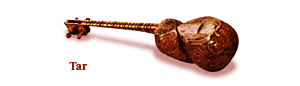
Tar
It is an 11-stringed, two-sectioned instrument with a body carved from mulberry wood, the top of which is covered with leather, featuring a long neck and played with a plectrum. It is one of the most important instruments of the Turks of Azerbaijan and Uzbekistan.
Murinhur
The rebab is a three-stringed, bowed musical instrument made by stretching skin over a coconut shell; its strings and bow are made of horsehair, and it has no frets. There is evidence that it originated in the Khorasan region, was brought to Anatolia along with Rumi, and developed within Mevlevi culture.
Nefir
It is made from the horn of a mountain goat. It is one of the traditional Sufi musical instruments.
Çetigen (Yatugan)
It is an instrument of Central Asian origin that is played on the knee with the fingers.
Miskal
It is a wind instrument of Asian origin, consisting of pieces of reed of varying lengths joined side by side, which is played by blowing into it. It is also depicted in Uyghur wall frescoes. It was used in Turkish music until the late Ottoman period. In South America and Romania, it is known as the pan flute.
Gubuz (Shan kopuz)
Although widely used in Central Asia, the mouth kopuz (gubuz, şan kopuz)—which is not very well known in our country—produces sound by playing into the mouthpiece of a metal or reed string mounted on a frame made of the same material. It is used by all Turkic tribes. It is the national instrument of Yakutia.
Tanbur
It has a long neck and seven strings. It is played with a plectrum made from a turtle shell.
Law
It is a 75-stringed, plucked instrument of Asian origin. It is played while resting on the knees.
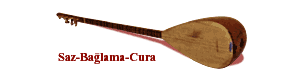
Saz, Bağlama, Cura
It has seven strings and a long neck. It is played with a plectrum. It is the most important instrument in folk music.
Mey (Balaban)
It is played by blowing into a reed piece attached to a wooden body resembling a kaval.
Squash violin (Gıçek, kemençe)
The body is made of a gourd or carved wood, and leather is stretched over it. It has a short neck and three or four strings. It is played with a bow.
Flute
It is made of wood. There are long and short varieties, as well as those with and without a reed. It is played by blowing into it.
Koray
It is an instrument made from the koray plant, with five holes, that is played by placing it between the teeth and blowing into it. It is an instrument from Bashkortostan. The Tatar koray, on the other hand, is a seven-hole, reed-equipped instrument that is played by blowing into it.
Sıbızgı
It is an instrument of the Kazakh and Kyrgyz Turks. It is played by placing it between the teeth and blowing into it.
Mazhar (Bendir)
It is made by stretching leather over a wooden frame. It is played by striking it with the hands.
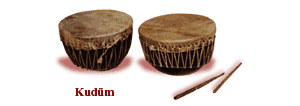
Kudüm
It is a double-bodied instrument made by stretching leather over a body of clay or hammered copper, played by striking it with wooden sticks called “zahme.” Among the Uyghur and Uzbek Turks, it is known as the “Çifte nagara.”
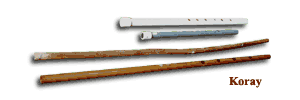
Koray
It is an instrument made from the koray plant, with five holes, that is played by placing it between the teeth and blowing into it. It is a traditional instrument of Bashkortostan. The Tatar koray, on the other hand, is a seven-hole, reed instrument that is played by blowing into it.
Halile, bell
It is made of two large bells. It is used to keep the rhythm.
Mazhar (Bendir)
It is made by stretching leather over a wooden frame. It is played by striking it with the hands.