



Pentatonic Melodies
Pentatonic Music and Its Influences
A term applied to any music, mode, or scale based on a system with five distinct pitches within an octave. In 1953, Constantin Brailoiu noted that the pentatonic musical system was found on five different continents and that ethnomusicological research was identifying an increasing number of cultures whose musical traditions were fundamentally based on pentatonic music. Brailoiu also noted that pentatonic music was used in ancient times.
Many of Europe’s traditional pentatonic melodies are considered anhemitonic (without semitones), and their scales consist of various combinations of major seconds and minor thirds (e.g., A C D E G, C D E G A, etc.) and, since these sequences can be confused with existing heptatonic (seven-note) scales, the term “gapped pentatonic” is used to describe them. A review of existing pentatonic tuning systems worldwide has shown that an octave can be divided into various intervals. Chinese and Japanese theorists provide lists of pentatonic scales with intervals equivalent to semitones and major thirds. On the other side of any comparative table of pentatonic tuning systems, one finds certain Southeast Asian and Central African tunings that are theoretically equally spaced (and in practice, nearly exactly equally spaced).(e.g., the Slendro modes of Java and the instrumental Ganda tunings of Uganda)
Pentatonicism has been explored by many European composers—most notably Chopin, Debussy, Puccini, Ravel, and Stravinsky—often in pursuit of exotic sounds. Pentatonic improvisations feature prominently in Carl Orff’s Orff-Schulwerk music education method.
06.06.2026
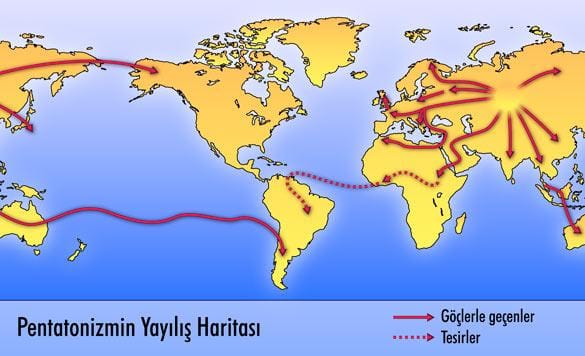
A map of the spread of pentatonic music by Benedict Szabolcsi, featured in A. Adnan Saygun’s work titled *Pentatonism in Turkish Folk Music*. The map identifies Southern Siberia and Central Asia as the points of origin of pentatonic music.
HISTORY?
Pentatonic Music
It is said that its influence extends from Southern Siberia to China, Japan, and India, as well as the northern and southern regions of the Caspian Sea, and from there to Europe, Africa, and the Americas.
Today, this genre of music can be found around the world in Central Asia, the Urals, China, Japan, parts of India, the Bali Islands, parts of North America, and Central and South America. Some musicologists refer to this music as “a gift from God.” The Japanese have conducted the most research on this subject.
Pentatonic music is the music inherent in nature itself and in human nature. Over time, it has evolved into the temporary form of music known as Classical Music. Classical music is known today as universal music throughout the world. However, this genre of music developed after the Middle Ages and, in that sense, is not universal. Research proves that pentatonic music is the universal music and that its origin lies in Central Asia.
The Influences of Pentatonic Music
This genre of music is very important because it is a cornerstone of music therapy.
Pentatonic music, which was banned in medieval Europe on the grounds that it had magical effects, has been used since 1979 at the Royal Institute of Music in England to treat children with autism.

The Use of Pentatonic Music Today
Pentatonic music is used today in jazz and in many forms of folk music.
Chinese and Japanese music have maintained a pentatonic system in over 90 percent of their repertoire. Ancient Celtic and Inuit music are also pentatonic. A pentatonic system is also found in certain musical genres in North Africa. It is also encountered in South Asia, Bali, Sumatra, and certain forms of Indian music. In Asia, it survives in its purest form primarily in the Ural region. This pentatonic music continues to be practiced in Kazan, the Bashkir region, certain parts of Siberia, and among the Kazakhs and Kyrgyz—particularly in mountainous areas.
Through his research, Sadi Yaver Ataman has found that pentatonic music is encountered, albeit to a limited extent, in the regions around Kastamonu, Safranbolu, Erzurum, Konya, and Eskişehir in Anatolia.
In a book titled *A Few Notes on the Pentatonic Melodies of Anatolia*, Ferruh Arsunar also lists the places where this music can be found. However, documentation on this subject remains extremely scarce. Pentatonic music has largely been forgotten in Anatolia.
The book *Biznin Cırlar*, compiled by the Kazan Turks in Finland, contains 1,000 pieces of five-part music.
Self-confidence and determination
At the Nordoff-Robins Music Institute, pentatonic music is used specifically in the treatment of children with autism. Since this type of music has been found to instill a sense of self-confidence and determination, it has proven to be very effective in helping children with autism open up. Piano improvisations are performed using this type of music, and the children are encouraged to engage in certain movements after listening to it for a specific period of time.
Research has scientifically shown that when an EEG is performed, it affects the alpha and theta rhythms in the brain, causing them to increase and inducing a trance-like state.

Pentatonic music and trance
It is related to the activation of certain neurons that are not normally used and the expansion of a person’s perceptual capacity. A person who normally uses only one-ninth of their brain can, when entering a trance, perceive information that is normally unseen—a phenomenon known as “clairvoyance.” It has also been observed that this type of music affects the endocrine glands and heart rate.
Normally, there are about 10 billion neurons in the brain. There are certain chemicals called neurotransmitters that facilitate communication between brain cells. When these chemicals decrease, brain function also declines. For example, in Parkinson’s disease, dopamine levels are reduced. This means that the flow of signals between neurons is very important. When this flow is disrupted, disease develops.
When a person enters a trance state, certain changes occur in the brain. The activity in the regions known as the temporal lobe, frontal lobe, and parietal lobe changes—it decreases—while activity in the region of the brain stem known as the posterior occipital lobe increases.
The brainstem is the most archaic part of our body. It is a vital organ we have inherited since the time of the first Adam. The oldest knowledge we carry—pertaining to Tawhid and the universe—is found there. Dr. Adnan Ziyalar, a professor at Cerrahpaşa Faculty of Medicine who also works as a psychiatric anthropologist, once said, “There is a place in the human midbrain where nothing but music has an effect.”
In fact, our colleagues working at the Meidling Clinic in Austria have observed that, in the neurology department’s intensive care unit, only music can heal patients in a coma, that patients can emerge from a coma through music, and that alpha and theta waves in the brain increase, with the patient entering a trance-like state while in a coma.
In a trance, a person begins to perceive things that cannot be perceived through normal consciousness, and the true self emerges. Trance is an important means for the true self to emerge. If meditative practices are directed toward all aspects of the inner world and are sincere and effective enough to connect with the human being’s infinite potential, a trance state can arise. Music can also facilitate this.
When we examine music from this perspective, we find that it has the ability to induce a trance-like state and, once in that state, to heighten intuition. Pentatonic music is also a significant factor in this regard. It is not yet known how it produces this effect.
06.06.2026